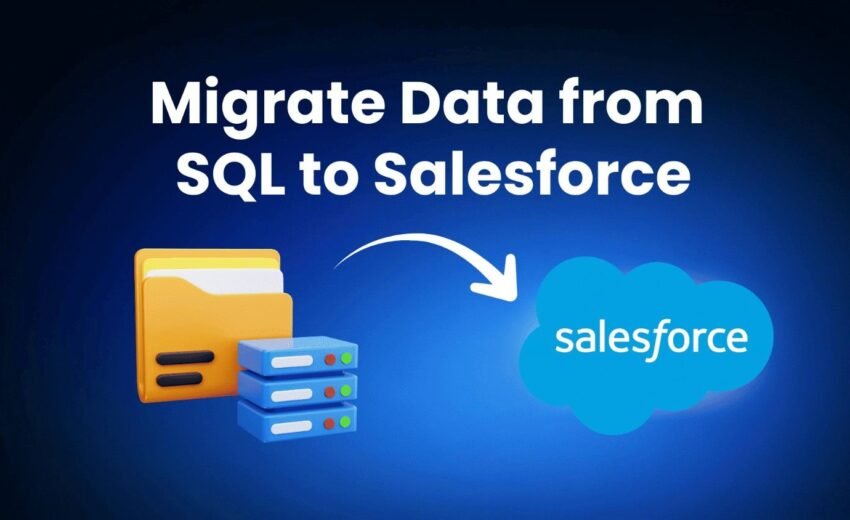
Generally the process of migrating databases from SQL to Salesforce can be tricky because it has quite lengthy and focused data management along the migrate data from sql to salesforce process. But it was not rocket science. This ultimate step by step guide you got the method for implementing a well complete salesforce data migration from another source.
Migrate Data from SQL to Salesforce : Behind Beneficial Role
In most of the cases business/enterprise can switch their database space orientation from Server based to cloud based CRM because it refers to countless advantages and upgrades. Such as : –
- Customer data centralization : Collect all data regarding – customer, sales, service, account info under a single cloud database.
- Data Automation : Implement Salesforce Automation to grow the leads, opportunity, customer support and workflow.
- Improve the Customer Data Visibility : Manage better customer insights and activity records for sales and service team analysis.
- Integration of Beneficial Clouds : Optimize migrate data from sql to salesforce for bringing connectivity with Marketing, Commerce, Finance like clouds.
- Better Support & Optimization : Salesforce ultimate support feature with AI Agent decreases the human support interaction and its way quicker then any normal action.
Rather there is also a huge list of salesforce features and complete overview about what salesforce is used for. But now discuss the actual ways to migrate data from sql to salesforce with 5 Different Processes.
5 Major Ways to Migrate Data from SQL to Salesforce Easily
A seamless troubleshooting solution for migration of databases from server to salesforce cloud needs a professional salesforce certified person for that I start choosing a salesforce implementation and consultancy firm who would help you if you don’t have any possible knowledge of salesforce.
Some best salesforce technician staff companies – BM Cloud Consultancy, Peeklogic, CodeLeo Consulting, GetOnCRM, CloudVandana, Etc.
Now you have other 5 ways if you have semi-level knowledge about salesforce working and terms.
SQL – CSV – Salesforce Data Loader

That process is easiest among all, You just take Necessary records that are first extracted from SQL and saved as CSV files. After that, you may insert, edit, or upsert the records into Salesforce using the Salesforce Data Loader.
Best for : Managed one-time loads and small-to-medium migrations.
Database Connection

In this process you don’t use process – export SQL data into CSV by hand. Through enabled database connectivity, Data Loader may interact with database sources, enabling the extraction and loading of data as part of the migration process.
Best for : Controlled migrations with very simple transformation requirements and a suitable connection to the source database.
Use of Migration Tool

Bulk API 2.0 effectively manages massive datasets, while ETL solutions like MuleSoft, Informatica, Talend, and Jitterbit extract, transform, clean, map, validate, and load SQL data into Salesforce.
Best for : Large-scale, intricate, and corporate Salesforce migrations.
API Implementation

To integrate SQL with Salesforce APIs, developers can create bespoke migration programs using Python, Java, C#, or Node.js. This allows for customizable transformations, duplication identification, relationship management, retries, logging, error handling, and conditional processing.
Best for : Projects with highly specific migration requirements or peculiar business rules.
Transform data by MuleSoft Database Connector

By extracting and modifying database data prior to loading it into Salesforce, MuleSoft facilitates enterprise SQL-to-Salesforce integration, allowing both initial migrations and continuous real-time synchronization between systems.
Best for : After the migration is finished, large companies will want Salesforce to be connected to SQL databases and other business systems.
These all methods have a high number of secure data migration rates from sql to salesforce but there are also some precautions to remember while using these methods.
Some Precautions before Migrate Data from SQL to Salesforce
1. Make a backup of your SQL data
Prior to migration, make a full backup of the SQL database. In the event that records are lost, corrupted, or improperly altered during the transfer, this provides you with a point of recovery.
2. Verify and Clean the Information
Before importing records into Salesforce, remove any duplicates, out-of-date, incomplete, or inaccurate information. Additionally, standardize forms for picklist values, phone numbers, email addresses, and dates.
3. Make a thorough field map
Clearly map Salesforce fields to SQL fields. To avoid import errors, verify data types, mandatory fields, field lengths, and relationships.
4. First, test the migration
Before transferring the entire dataset, conduct a brief test migration in a Salesforce Sandbox. Test automation, validation rules, relationships, field values, and record counts.
5. Make a plan for relationships, mistakes, and validation
Determine the proper migration sequence and parent-child relationships. Prior to the production migration, create a rollback or recovery plan, keep error logs, and use External IDs as necessary.
Final Thoughts
Better data management, automation, and accessibility are made possible by migrating SQL data to Salesforce. Accuracy and security are guarantyd through careful preparation, validation, and dependable migration techniques.